Actually own your games.
We're building a store for today's games where what you buy is really yours. Keep it. Gift it. Sell it when you're done. Nobody can take it back, not a publisher, not even us.
Gamakura only gets built if enough players raise their hands. That's exactly what your sign-up does.
You bought it. They can still take it away.
This isn't a scary story about the future. It's the news from the last few weeks.
Purchases revoked
People paid real money for movies on their Playstations. Then the licenses were pulled, and the movies disappeared from their PSN libraries. No refund. No recourse. Your games are subject to similar terms.
SONY / STUDIOCANAL, 2022-2026Discs, discontinued
Sony has decided to stop manufacturing discs for new PlayStation games starting January 2028. The era of "buy it once, keep it on your shelf" is closing, one format at a time. There is a future where we can save physical.
SONY, 2026Builders, laid off
Thousands of the people who actually make games lost their jobs this year. Studios close. Servers go dark. Games vanish. Support a more sustainable direct funding model for devs and your library.
XBOX, 2026Here's the part most people miss: on almost every store, you don't buy games. You buy permission to play them. And permission can be taken back. Read Steam's terms sometime. It says so right there. We'll wait.
See for yourself: they're not your gamesWhy I'm building this.
I'm not a faceless company. I'm the founder leading this, and I bring a weirdly specific resume: years of delivering media to millions of people, building payment systems, and working with open ownership tech. The exact three things this platform needs. I'm not going it alone either: my biz partner has my back, and a crew is ready to build the moment funding lets us do right by them. Here's my honest three minute pitch. The plan, the risks, and why your interest is what makes it real.
What "actually own" means here.
Nobody can take it from you
It stays in your library as long as you want it there. No one can delete it. Not the publisher. Not us. Short of an electromagnetic pulse taking out every computer on earth, your library is safe.
Play it perpetually, or maybe not at all
Download the whole game and play. It's yours and playable whether we or the dev studio still exist. You may also add it to your ever-growing backlog. We don't judge.
Sell it or gift it or become a hoarder
Done playing? Pass it on or sell it, the way you could with a disc. We make resales and gifting simple. We also enjoy enabling your digital hoarding problem so feel free to add to the pile.
All three of those are the opposite of what the stores you use today actually promise.
Learn how Sony, Nintendo, Microsoft and Valve say you own nothingA store that feels familiar.
A library that's finally yours.
We're building in the open, so here's a peek at a very early build, rough edges included. Where this is headed: browse new releases, buy, download, play. And when you're done, sell or gift straight from your library.
Feels like every store you already use.
Buy like normal
A plain old credit or debit card is all it takes. If you can shop on Steam, Xbox, or PlayStation, you can shop here.
It goes on the record
Your license is created on an open public network. Anyone can check it. No one can erase it. Only you can use it.
Play, keep, resell
It's yours now. Keep it forever, gift it to a friend, or sell it secondhand when you're done. Remember when that was normal?
Powered by blockchain tech minus the bullshit.
Yes, we said blockchain. We know how that word lands with gamers, and honestly? It's a fair take. The tech was co-opted by scammers and speculation. So here is exactly what we're doing with it, and everything we're not.
No coin. No token. Nothing to trade.
No million-dollar cartoon JPEGs.
No prediction markets, no "when lambo" or "LFG"
No mining, no GPU hoarding, no wasted electricity.
Putting your game licenses on-chain, so they persist beyond any one company and truly belong to you. A receipt no one can tear up, not a publisher, not us. That's it. That's the whole trick and the kind of thing NFTs were originally created for.
Ethereum mainnet
The O.G. blockchain that has run for over a decade and survived every market crash. No single company owns it, so your proof of ownership doesn't depend on our servers or the whims of shareholders.
And no mining, it runs on proof of stake. The graphics card stays in your PC, where it belongs.
Delivered By BitTorrent
Yes, that BitTorrent.
The tech that has refused to die for twenty years is quietly great at exactly one thing: moving big files without a middleman. Your games come from a network everyone shares, so there is no single server anyone can shut down.
Crappy movie rips with baked-in subtitles
Neckbeard Linux distros you used for 2 minutes
Ill-gotten private photos of celebrities
Your game library, delivered fast and kept alive forever
Games are culture. We keep losing them.
Old movies have archives. Old books have libraries. Games? When a store delists one or a server goes dark, it can be gone for good. Not "hard to find." Gone gone. And today's download-only games can vanish even faster than cartridges ever did.
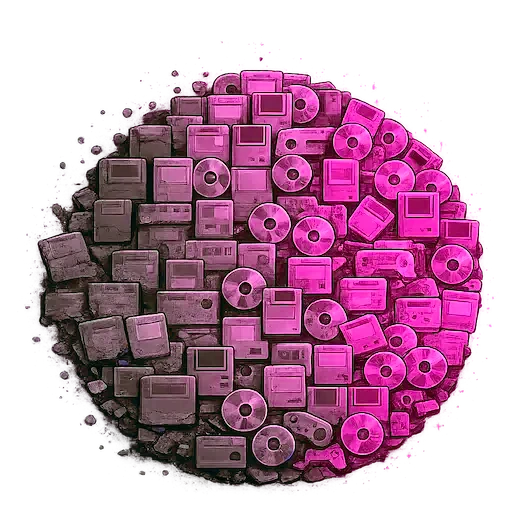
Almost nine out of ten games released before 2010 aren't sold new anywhere today. Everything that loses its color here is a game that's out of print. (Video Game History Foundation, 2023)
If a studio goes dark, the locks come off.
It's written into our terms: if a studio shuts down and nobody's left to run its DRM, the DRM switches off. Your game keeps working. A dead company should never take a living game with it.
A licensed soundtrack shouldn't kill a game.
Games have vanished from stores because one licensed song expired. We work with developers up front so that when a music or content license runs out, the game survives. Swap the track, keep the game.
We didn't bolt preservation on. It's how the whole thing works. Your ownership lives on an open record, and the games live on an open network. Nobody, including us, can make a game disappear. The games you love today stay playable for the kids who find them in thirty years.
Your games shouldn't care what computer you own.
Owning your games also means choosing where you play them. Your operating system shouldn't watch what you do, fill your desktop with ads, or need an exorcism after every update. There's never been a better time to have options. We can't promise every game runs everywhere, but we reward developers who make theirs run on all three.

Windows
Where most of you are today. Full support from day one, no judgment. Okay, a little judgment.

Linux
Free, fast, and it doesn't spy on you. Gaming on Linux has never been more ready, and we're actively helping developers ship for it.

macOS
Modern Mac hardware is genuinely great for games now. We treat it that way. Native builds, not ports that show up two years late and tired.
Lost your studio? Going indie? Tired of forking over 30%? Build with us.
Thousands of talented developers have lost their jobs in the last couple years. We're building a place to land, whether you're a laid-off team or a solo dev with a dream and a questionable sleep schedule.
Keep more money. The industry standard 30% cut is egregious (especially for small teams). Our platform fee is substantially lower.
Your players, your relationship. You see who buys your game. Talk to them directly.
Get funded before you ship. Players can back your game with preorders. Money up front, released milestone by milestone.
Your game outlives you too. Open distribution means your work never depends on one server staying up.
Ship everywhere, preserve forever. We help you launch on Windows, Mac, and Linux. The tech has never been more aligned, and cross-platform is how games survive.
The conversation is already happening.
Everything on this page is being debated, tested, and built in the open, and the conversation happens on Discord. The waitlist is how you raise your hand. The server is where you get a say.
Talk to the humans building it
Ask anything. A real person answers, usually the founder, usually the same day.
Shape what we build
Roadmap calls, feature votes, and honest trade-offs, argued in public before anything ships.
See it before anyone else
Early builds, rough screenshots, and the occasional glorious bug, straight from the workbench.
The founding team is in the chat. Come say hi, or just lurk. Lurking counts.
Join Our DiscordEvery member is another raised hand that helps get Gamakura built.
Fair questions, straight answers.
The things people always ask us, including the awkward ones.
Ask us anything. A human reads every message, and right now that's usually the founder.
Is Gamakura just for retro games?
No. The cartridge is our mascot, not our inventory. Gamakura is a store for modern PC games: new releases and fresh indie launches from developers who ship here. The cartridge just stands for a feeling we want back: pay once, it's yours, no takebacks. The look is nostalgia. The catalog isn't.
So when did we actually stop owning our games?
Later than you'd think, and not with cartridges. Discs kept ownership intact: a PS1, PS2, or GameCube game was yours to lend, resell, or shelve forever, no account required. It started slipping in the mid-2000s. Half-Life 2 made you activate a Steam account to play in 2004, the Xbox 360 and PS3 made day-one patches, hard-drive installs, and digital stores routine, and by 2010 some publishers charged secondhand buyers a fee just to switch on the online modes. That's when 'buy' quietly became 'license.' We're here to undo it.
Do I actually own the games I buy here?
Yes, and that's the whole point. On other stores the fine print says you bought a revocable license, and California law now makes some of them admit it right at checkout. Here your license is recorded on an open public network, it transfers with you, and nobody can revoke it. Keep it, sell it, gift it, even leave your library to your kids someday.
Is Gamakura a Steam alternative?
Yes, in the sense people mean when they ask: a PC game store where you browse, buy, download, and play, with none of the crypto homework. The difference is what you walk away with. Steam's own subscriber agreement says your purchases are licenses, and its terms block reselling them; our license is transferable on purpose. Keep it, gift it, sell it when you're done. Think of us as an open Steam: the store part feels familiar, the owning part is new.
Is this a crypto thing? Do I need a wallet?
No wallet, no seed phrase, no gas fees, no coin. You pay with a regular card and sign in like on any other store; we handle the on-chain part for you, invisibly. The blockchain does exactly one job here: keeping a public, permanent record that your license belongs to you. Everything else works like a normal store, on purpose.
What happens to my games if Gamakura shuts down?
You keep playing. Your licenses live on Ethereum, not on our servers, and your downloads come from a shared BitTorrent network with no single plug to pull. If we vanished tomorrow, your proof of ownership and your games would still be out there. We built Gamakura so you never have to trust us. That's exactly why you can.
Can I really resell my games? How does that work?
Yes, in a couple of clicks. Other stores ban resale in their terms, and courts have largely upheld those bans. Our license is written the other way: transferring it is the feature. When you resell a game the developer earns a percentage of the sale, and we take a small fee that covers the cost of moving the license on-chain. The rest is yours.
What happens when a studio closes or servers go dark?
A dead company should never take a living game with it, so it's written into our terms: if a studio shuts down and nobody is left to run its DRM, the DRM switches off and your game keeps working. Expiring music and content licenses get sorted with developers up front, so the game outlives the paperwork. We can't fix what other stores already lost. Everything sold here stays playable.
What can I play on? What about phones or consoles?
Gamakura is a PC store to start: Windows from day one, with Linux and macOS as first-class citizens, not afterthoughts (we reward developers who ship on all three). Phones are on the roadmap. Android already allows outside app stores, so it's a realistic next step. iOS is only just cracking open, where the EU now forces Apple to allow third-party stores and other countries are starting to follow, so as that spreads we'll absolutely go there too. Consoles are the holdout: Sony, Microsoft, and Nintendo don't allow third-party stores on their hardware (their own storefront is the only way in), so those aren't in the cards yet.
Who's actually behind Gamakura?
A small team, with more ready to join. I'm the founder leading it day to day, backed by a business partner in a support role, plus a group of people lined up to come aboard the moment we're funded well enough to pay them right. That's part of why the waitlist matters: it's the proof that turns a lean crew into a fully staffed team. We'd rather grow honestly than pretend to be bigger than we are.
When does it launch, and what does it cost to join?
The waitlist is free and takes ten seconds. We haven't announced a launch date, because the honest answer is that Gamakura gets built when enough players raise their hands. Signing up is how you raise yours, and it's where the date will land first.
Help us prove people want this.
You've seen the plan. Now we need the proof. We're a small team taking on giants, and every raised hand makes us harder to ignore. Signing up is free, it takes ten seconds, and it scares exactly the right people.